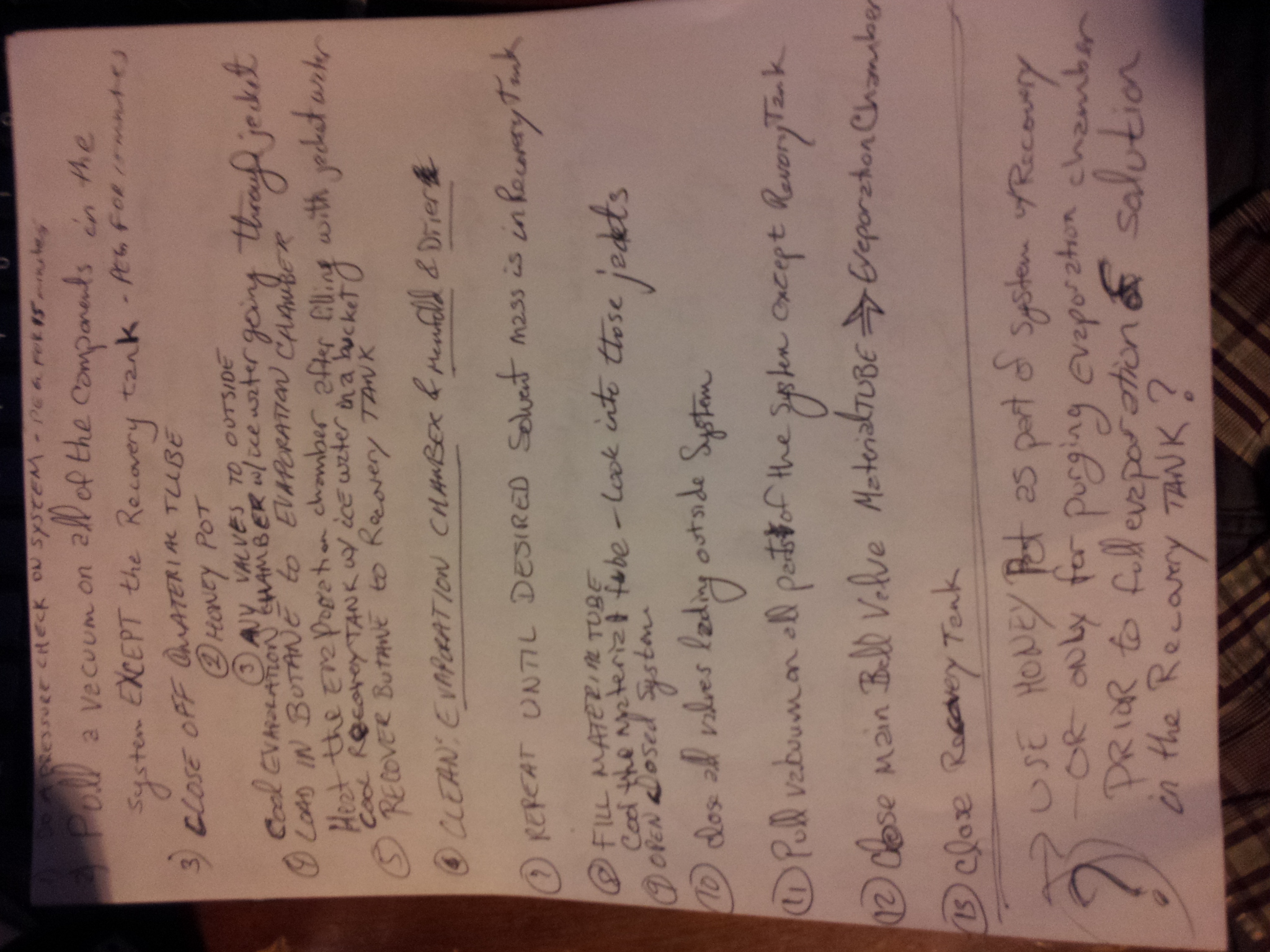
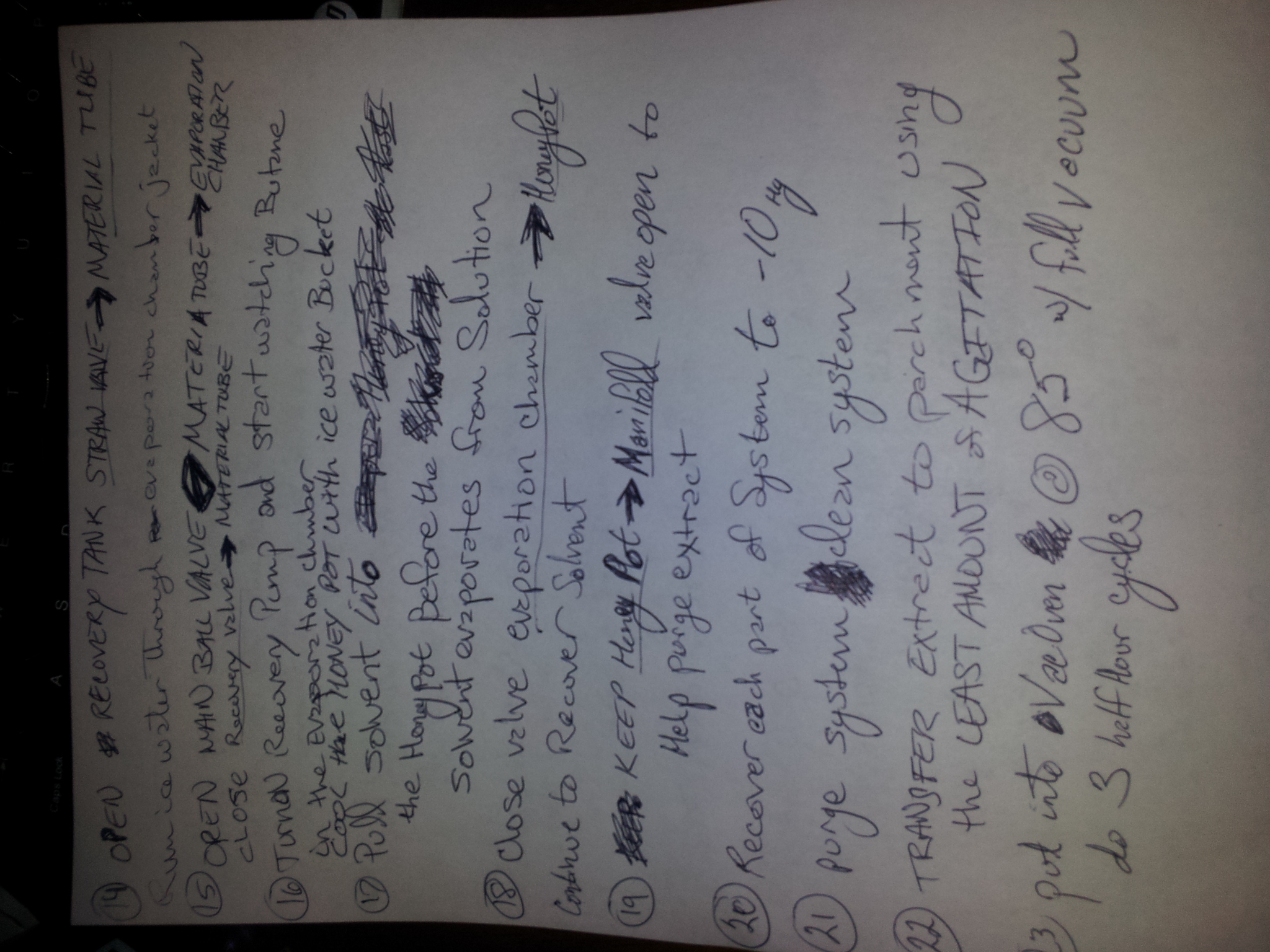
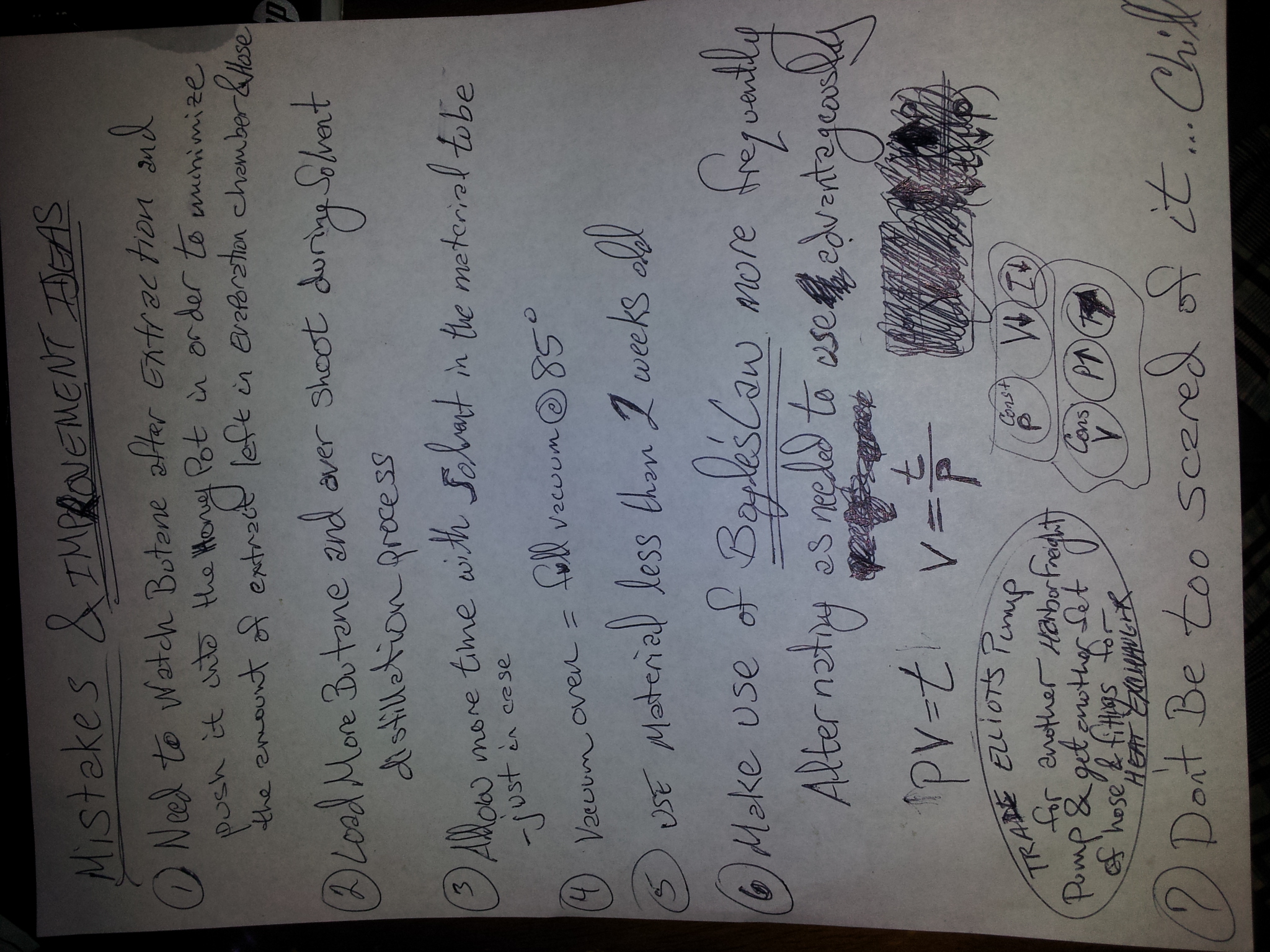
Just some notes I've been taking...
These come from a variety of sources do much respect and all credit due.
Super golden Light 70 hours at 102 degrees. Darker 75-80 hours at 104 degrees.
Our extraction method ensures the same care for quality as our growing practices. We freeze the
cannabis to preserve its flavor and medicinal qualities and then run the full plant, in strain-
specific batches, through a closed loop extractor. After reclaiming the gases used in the
process, we purge the product of any residual gas particles for 12-72 hours, or even longer if
necessary. Stay tuned through the year as we move towards live plant resin extracts.
Parker C-082 Filter
Parker 303 Filter
Originally Posted by surfguy1936 View Post
hey Gray wolf so i have the C-082 filter already on my recovery pump, so with that would i be
able to clean out the tank if i just run it through. Because I have seen liquid go through the
little glass screen on it a couple times
Any of the filter dryers will work, if they are large enough and aren't already saturated. We use
an E-032 as an inlet guard for the pump and add another filter to dry out the butane.
The 082 will work until it gets saturated with water. I use the 032 for pump protection, and
would use the largest that I could accommodate for drying and periodically dry it out in a 200F
oven as needed.
We actually have a Robinair refrigerant pump and filter dryer, which pumps in a circle from the
tank, through the filter dryer, and back to the tank. It has a replaceable element, which can be
baked out to regenerate.
we used a mixed gas....
the heating vessel circulates water at 90 degrees and my recovery tank is just in an ice water
bucket. about a 45 min full recovery time for 4.5# of mixed gas
You might try dropping the 90F to 80/85F. Amazingly, the color starts at about that level.
We use 85F and get light extracts, but much more and they darken.
1. Always let sit in your oven for 30 minutes prior to pulling a vacuum. This will greatly reduce
the muffining effect and your oils will use gravity to make its own thin film.
2. Time > Temperature. Set that shit at 103, let run for 6-8 hours. Then release vacuum and let
set for 30 minutes. Take it out and flip it. Repeat. Patty flipping is just common sense for the
most part. You really don't have to go 'thin film' necessarily if you do this properly. Once your
patty stops looking like the toxic avenger and those oil on water rainbow bubbles stop bliping,
your shit is pretty much done. An extra 30 min for good measures.
3. Fabricate a dry ice sleeve around your column of your closed loop. -40c will help freeze some
plant fats and waxes (waxy membrane around trich head) and not allow them to pass through your
screen. Too much plant fat and wax will make your shatter (autobudder) over a short period of
time.
4. Do not touch your shatter with your oily ass fingers. This will cause autobuddering. Do not
fold in more than once to make a patty, or you will increase your chance of autobuddering.
5. Use a buchner funnel/lab filter and passive vacuum system to completely dewax your oils. You
have to either keep adding butane or bury the funnel in dry ice to keep your tane chilled -40c.
If you smell the wax you get off of using dual solvent winterizing process, you will notice it
smells better than your oil. If you use a single solvent for dewaxing, hte wax has no smell;
therefore, full terpene retention in the oils. Use a buchner funnel only if you want 100% wax
free shatter. You can get a good 80% out by using dry ice and a 25micron screen. You can't see
how much wax is present in your shatter until you dewax it You typically lose about 15% yield
doing this.. but if youre a connoisseur, i say go for it.
6. Stop smoking wax. Seriously. You are smoking a bunch of unnecessary plant materials in your
product. The stuff that makes you feel like you got kicked in the chest... thats WAX.
https://www.youtube.com/watch?v=E8pIiq1t5fU
7. Never turn your vacuum pump off while in the oven. Yes AI ovens have a vac-lock mechanism but
the problem is that as they hydrocarbons boil out of the oil, they release a very very very small
fraction of vacuum in your oven; thus, slowing down the purge; thus requiring you to add more
heat and longer times that make your oils dark. You simply get more action by leaving the pump
running throughout the whole purging process. This will yield you lighter oils.
8. Never let your collection vessel exceed 80degrees F when recovering your tane. Always leave
about 5% gas in your collection vessel to act as a carrier solvent for your oils. This will speed
up the cleaning and scraping times, but will lose you 5% gas (a few bucks) but lets face it..
time is money.
9. Learn how to calibrate your AI oven. It came with the instruction manual and the guys at AI
will gladly assist you in breaking down the PV/SV and what it means to your oils.
10. Safety first. Gas mask, lab coat, gloves? check. walk in lab hood that pulls 2700cfm? check.
Proper fire suppression and explosion proof equipment? check. Do not cut corners here. Lots of
people die OVER SOME WEED because they want to make money
Originally Posted by Roji View Post
Im starting to question the need for such industrial machines for these relatively sensitive procedures we do . Is there any reason we need such bulky and heavy duty units? I'm wondering if a top load plain old vacuum chamber with stackable heated shelves fitted inside would be functionally similar to these new fancy highly technical ovens for a fraction of the cost. My ten gallon vac chamber has 1.33 cubic feet. Decent amount of room.
Am I missing something here? Are heated sides really necessary after we have gone to heated shelving?
Why are you even asking rhetorically?
KISS:
Simplest single walled box with front facing door that can hold a vacuum without imploding, there's no high heat from radiant heaters to weaken it... a full size plexiglass window for a door, like the top of a stock pot vacuum chamber, would be slick.
Several aluminum shelves with adhesive backed, full coverage silicone heaters stuck to the bottoms (two or three hundred watts per shelf should be more than enough imo)
PID temperature controllers with solid state relays for each heater in a little external box
The gauge and valve 'manifold' composed of a couple of cross connectors can also be completely external with just one hole in the chamber for the vacuum plumbing entrance, or two if you want to backfill with nitrogen, etc.
Silicone heat mats, each with it's own sensor and PID controller. The only way to get perfect tracking is to directly monitor the oil temperature, IR temperature sensors should do, since this is a low temperature specific oven. They start at about $150 each,
http://www.omega.com/subsection/fixe...ermometer.html
Just mount a sensor pointed down above each heat mat.
If you place soft padding/insulation under each heat mat, the mat will tend to conform to the uneven (concave) outside, bottom surface of many Pyrex dishes. I doubt you'll find any dishes that are perfectly flat on the bottom, and it would be necessary to ensure good contact with a solid heated shelf.
For the silicone heat mats (they're called heaters,) 1.25 watt per square inch is plenty, and should be able to withstand full power in free air. Here's a Temperature versus Wattage in fiberglass heaters graph,
http://www.omega.com/toc_asp/framese...ro_flexheaters
The 1.25's are the SRP Series from Briskheat, Briskheat sells direct, Grainger's also carries them, so does this place,
http://www.oemheaters.com/c-541-srp-...-wsq-inch.aspx
That, and the box and you're good to go. The window should be large enough to allow full viewing of all levels so you can adjust the action on the fly...
Of course you can also toss your oil on parchment in there, right on the heat mat. You can even mix Pyrex and parchment, why is radiant heat still even being considered?
Water Jacket Temp 85 degrees
102 degree Heat Mat BestVac
We pull at 50% clear to 100% milky, usually 12-7 days immature.
All rh levels are below 20%
also, pulling a hard vac really quick can often result in waxing. best to pull partial vacs and let the butane escape slowly. if anything, slow and steady is the better way.
So I have some facts not after digging. We have been speaking frequently with the owner of a WA company that works very closely with extracted.
The gas depends on the material. For example propane is used for older cure material. When propane is used the vibrant colors and light terpenes are retained because of the ultra low boiling point of the solvent.
They run Extraction Tek systems and csresavers. Way over priced systems they told me each set up cost 25 grand. The do not use tamesiums
They use very large pumps to bring purge times way down.
To achieve the muffin the use a warm water circulator around the pot during propane extractions and pull a super hard vac. This and a few other steps will yield the stable muffin.
We use an ETS just like xtracted, FOA, lunchbox, etc. The prepurge muffin is just hard vacuum while the collection pot is cooling after a hot water circ. The pour prepurge is accomplished one way by heating you hot water circ to 90-100F...The oil will be a VERY low residual solvent syrup that hardens immediately. I don't like the pour because you can get oil all over the pot and spend precious extraction time scraping (potentially causing nucleation).
They also do propane butane blends. It has a lot to do with how you handle and prep your material as well. We have broken the code and now producing the same caliber oil as xtracted good luck everyone.
I read 8 pages of this post, no one mentioned that shatter comes from non agatated oil. If you scrape then scrape razor, then scrape again etc, you get butter. If you blast into Pyrex let it purge to a point where it's sludge, then with a flexible spatula scrape corners and whole pan with as few smooth strokes as possible. Then let gravity run the oil from spatula to parchment , you can guide it with a razor. Once it is on parchment let it sit in oven for 30 before pulling vac. I start at 95deg Fahrenheit, and each flip I go up 1degree. After flip let sit for 20-30 before vac again. After a few days I usually end up with solid shatter. If warmed up a bit it can be flexible...no idea why pics won't post but hopefully this helps a few people...yes I don't have many posts on here...but that's cuz I really don't care to have one more thing to keep up with.
https://www.icmag.com/ic/showthread....shatter&page=3
I've been running an ETS with 99% pure propane from General Air out of Dillon, CO for a little over 6 months now, and I find that the yields are lower, but the product is far lighter when pulling it out. I've been purging at temperatures in the 80's and have had some awesome results, but this comes after whipping the material at 125 degrees until it turns creamy. Toss it in the 80ish degree oven, and it muffins up and turns to a glorious crumble. My best crumble test result was 96.3% THCA from some Blue Dream trim. For some reason, though, even though when I first pull it out of the collection vat and of the oven it smells great, when it comes to dabbing it, it leaves room to be desired as far as terps is concerned. Maybe they're evaporating when I'm whipping at 125?
If this same whipped material is purged at 110ish or higher, I've found it makes the material a more earwaxy material, rather than a flakey crumble. A small bit of brightness seems to be compromised when making it the wax instead.
I've tried to make shatter with propane as well, and have had decent luck. Without whipping, I've purged the hash at around 100 degrees, and gotten some rather stable and bright shatter. The issue for me has been that the shatter I make with propane auto-budders HARD after about 2-3 weeks. Had some dispensaries call and complain of this, though the auto-budder is still rather tasty. Highest test result with propane shatter was a 97.9% THCA 303 Kush.
I've thought about taking my once-run material and steam distilling it for remaining terps, then adding it to the material while I'm whipping it. Would that work with material that's already been run? Sometimes the cannabis still smells good when I'm unloading the column, so I've gotta guess there's still some goodness in there.
Tried doing some live-resin with propane, had KILLER results. Some Island Sweet Skunk for Hashish House in Pueblo turned out to be a yellow-wet-sand look, and had the best terp profile of anything I've ever blasted with the ETS. I guess they're selling it 100/g out here in CO :/ Did a shorter soak, no whipping, and a purge at about 85 degrees. About to start playing with another several loads of live resin from them this morning, any advice?
The ETS is capable of holding pressures of up to 300psi, and I've seen it get as high as 160 when I'm using it. I heat my propane tank before I release it for a soak, I've tried soaks for anywhere from 5 to 30 minutes, and I still get awesome colors. I think the collection pot is an 8", pretty tall and tough to get into.
Dispensaries like the PHO because it's bright and smelly, making it easy to sell.
Try this method for shatter, and see if never exposing it to vacuum deeper than -29.5" Hg solves the waxing up problem.
Thin film, 110-115F @ down to, but no lower than -29.5" Hg. Purge until the boiling slows to a crawl, only takes about forty-five minutes to an hour with a few grams. I raise and lower the muffin a couple of times at the beginning.
My opinion is taking the vacuum below the boiling points of the many of the oils components is disrupting the matrix.
Yeah, that's why we say wax sucks, smells good just sitting there, but dabbed it's just not there anymore...
Thanks for sharing about the propane results, I don't think I've seen any PHO at my local MMJ dispensaries. At the moment nobody in SoCal is denying what they're selling is BHO, so I don't know why they wouldn't brag about it being PHO if it was...
Btw, I came home from the Cannabis Cup with three shatters from Paper Planes, and now the third is also turning to wax...dudes get your definitions correct, you're confusing solidity with stability, here's a pic, they were all originally in parchment folds where they deteriorated, and now continue to deteriorate... I actually paid for this...why I really want to be able to continue on making my own oil for my own personal use.
The fastest way that I've found to purge propane or butane, is for the surface tension of the puddle to be low enough for the gas molecules to readily escape from strike angles shallower than 90 degrees. With the strains we tes
ted, that temperature fell somewhere around 110/115F.
Not to be confused with the oven temperature setting, as it was measured at the puddle surface itself.
The terpenes we are targeting are well below their boiling points, but sublimating off, faster under vacuum, so we want to limit how long we pump.
Heat also changes the nature of some terpenes, through processes like decarboxylation and oxidation, so another reason to minimize how much and for how long.
It is common to distribute a mixture of propane (C3H8) and butane (C4H10) (LPG) for combustion purposes.
Propane is more suited to colder environments since it evaporates at -44oF (-42oC) at atmospheric pressure. Butane evaporates at 33oF (0.6 oC) at atmospheric pressure.
The vapor pressure of a mixture of the two products are indicated in the table below:
Vapor Pressure (psig)
Mixture Propane (C3H8)
(%) 100 70 50 30 0
Butane (C4H10)
(%) 0 30 50 70 100
Temperature
(oF) -44 0 0 0 0 0
-30 6.8 0 0 0 0
-20 11.5 4.7 0 0 0
-10 17.5 9 3.5 0 0
0 24.5 15 7.6 2.3 0
10 34 20.5 12.3 5.9 0
20 42 28 17.8 10.2 0
30 53 36.5 24.5 15.4 0
40 65 46 32.4 21.5 3.1
50 78 56 41 28.5 6.9
60 93 68 50 36.5 11.5
70 110 82 61 45 17
80 128 96 74 54 23
90 150 114 88 66 30
100 177 134 104 79 38
110 204 158 122 93 47
1 psi (lb/in2) = 144 psf (lbf/ft2) = 6,894.8 Pa (N/m2) = 6.895x10⁻³ N/mm2 = 6.895x10⁻² bar
Note that the evaporation temperature is not the only parameter that influences on evaporation of the propane butane mixture. Evaporation requires heat and if the heat transferred to the liquid gas is limited - the liquid cools down and the evaporation is reduced.
Larger consumers requires heat exchangers fueled with hot water, electric heater or combustion of the propane butane mix itself to supply the evaporation heat.
Smaller consumers requires propane butane mix containers with efficient heat transfer from the surroundings. By example - composite containers provides less heat transfer compared to steel containers and may cause problems at lower surroundings temperatures.
 THE BHOGART PROJECT